AI governance your security team will sign off on
As AI authors more of your codebase, accountability becomes a control problem. Kodela gives platform and security teams the deployment, identity, and governance controls to keep it legible — at scale, and on your infrastructure.
Accountability for AI-authored change
Every change carries an actor, a risk rating, and its reasoning. Governance turns that record into enforceable policy.
SSO & SAML
Federate identity through your IdP. Provision and de-provision access centrally.
RBAC
Granular roles control who can read context, author decisions, and sign off on high-risk changes.
Audit & retention
Immutable audit logs and configurable retention satisfy compliance and security review.
Air-gapped deployment
Run Kodela fully self-hosted, including disconnected environments with no outbound traffic.
Private LLM governance
Keep enrichment and synthesis on models you control. Your context never leaves your boundary.
Policy engine
Codify governance: required sign-offs, risk thresholds, and drift policies enforced automatically.
Your infrastructure, your rules
Choose the deployment that fits your risk posture — from fully managed Cloud to a self-hosted, air-gapped install.
- Managed Cloud with SLA-backed availability
- Self-hosted on your own Kubernetes or VMs
- Air-gapped install for regulated environments
- Postgres-backed shared memory you operate
- Bring-your-own-model for enrichment & synthesis
Built for platform teams
Kodela is infrastructure, and it behaves like it: documented boundaries, a real API and SDK, CI integration, and a data model you can build on. Roll it out across teams without fragmenting how context is captured.
- Tool-agnostic
- Consistent capture across every AI tool
- Self-hostable
- Run it where your code already lives
- Auditable
- Immutable logs for every action
- Extensible
- Plugins, API, and SDK
One org brain, every developer
Team and Enterprise editions sync each captured why into a Postgres-backed org memory automatically — no developer runs a manual sync. Anyone can ask it in plain language and get the same answer, drawn from every repo the org has mapped.
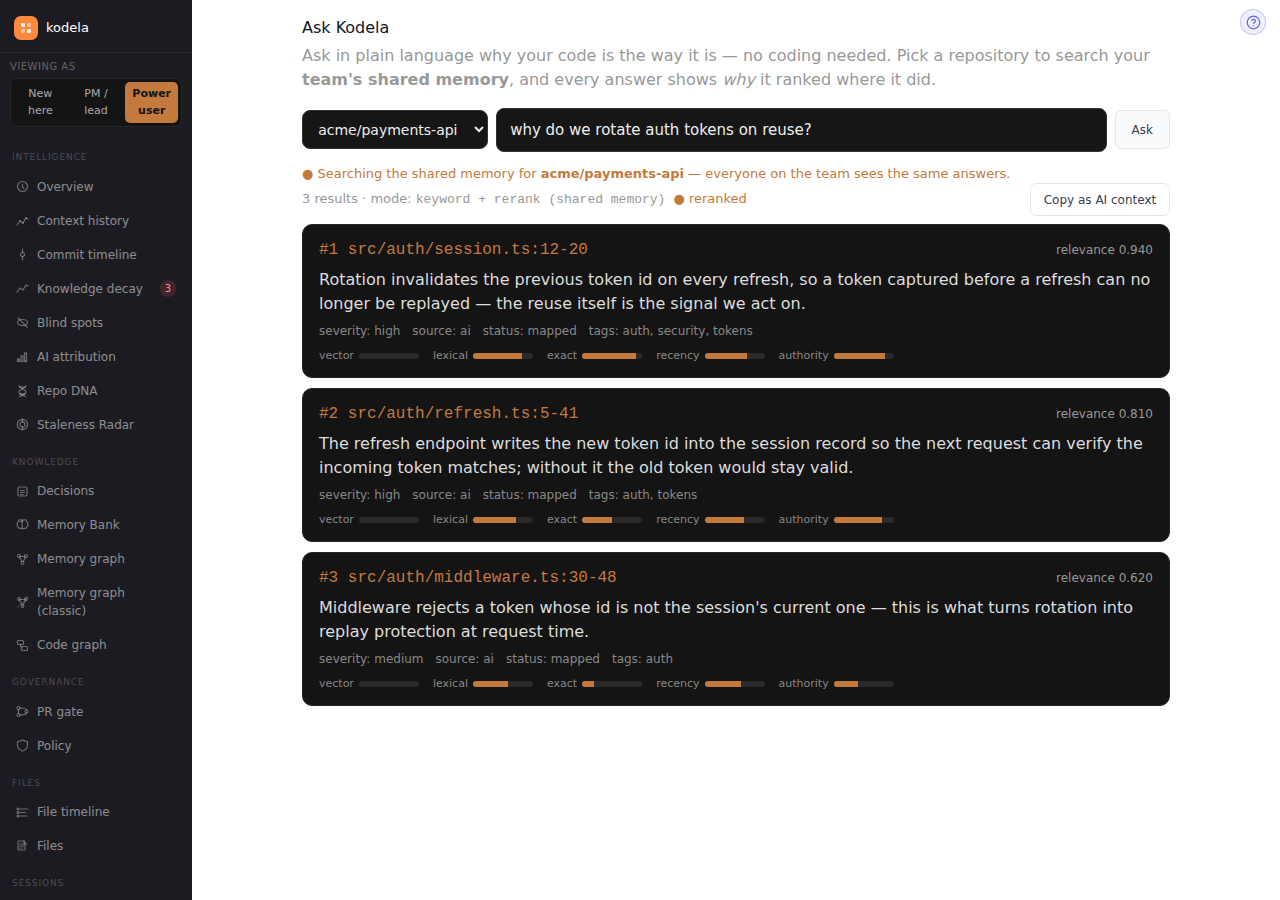
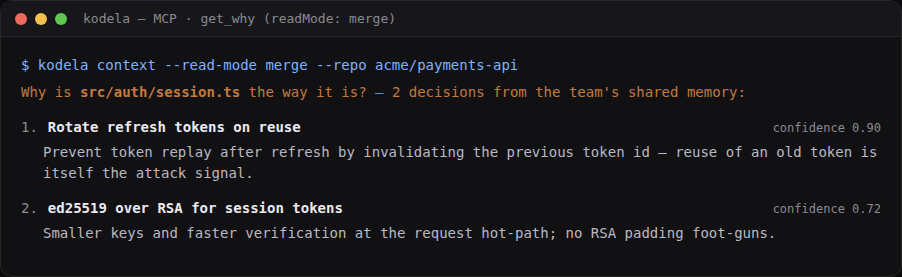
get_why over MCP for the same answer.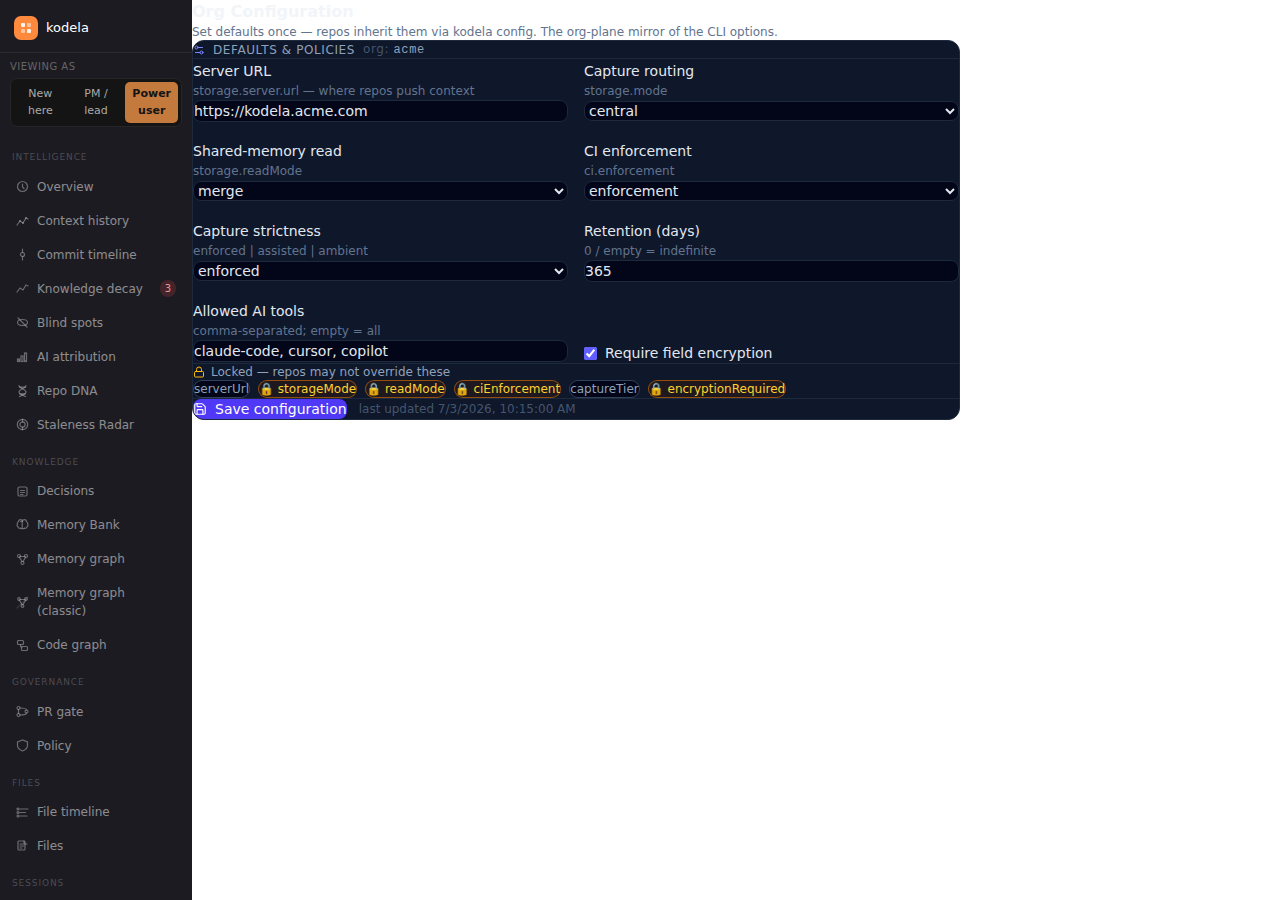
A single storage.readMode — local, remote, or merge — decides whether a developer's CLI, MCP tools, and dashboard read their own machine, the org's shared memory, or a deduped union of both. Query it by repository name; admins set the defaults and lock the ones that are policy.
Is your AI honoring the decisions it was told about?
Kodela is the only tool that pairs auto-captured why with automated decision-violation detection. When a change reverses an active decision, it's flagged — before review — on every layer: a pre-edit MCP guard, kodela check in CI, the PR check, and a governance scorecard for leaders. High-precision by design (only active decisions enforced): 100% precision, 0% false positives on the seeded corpus.
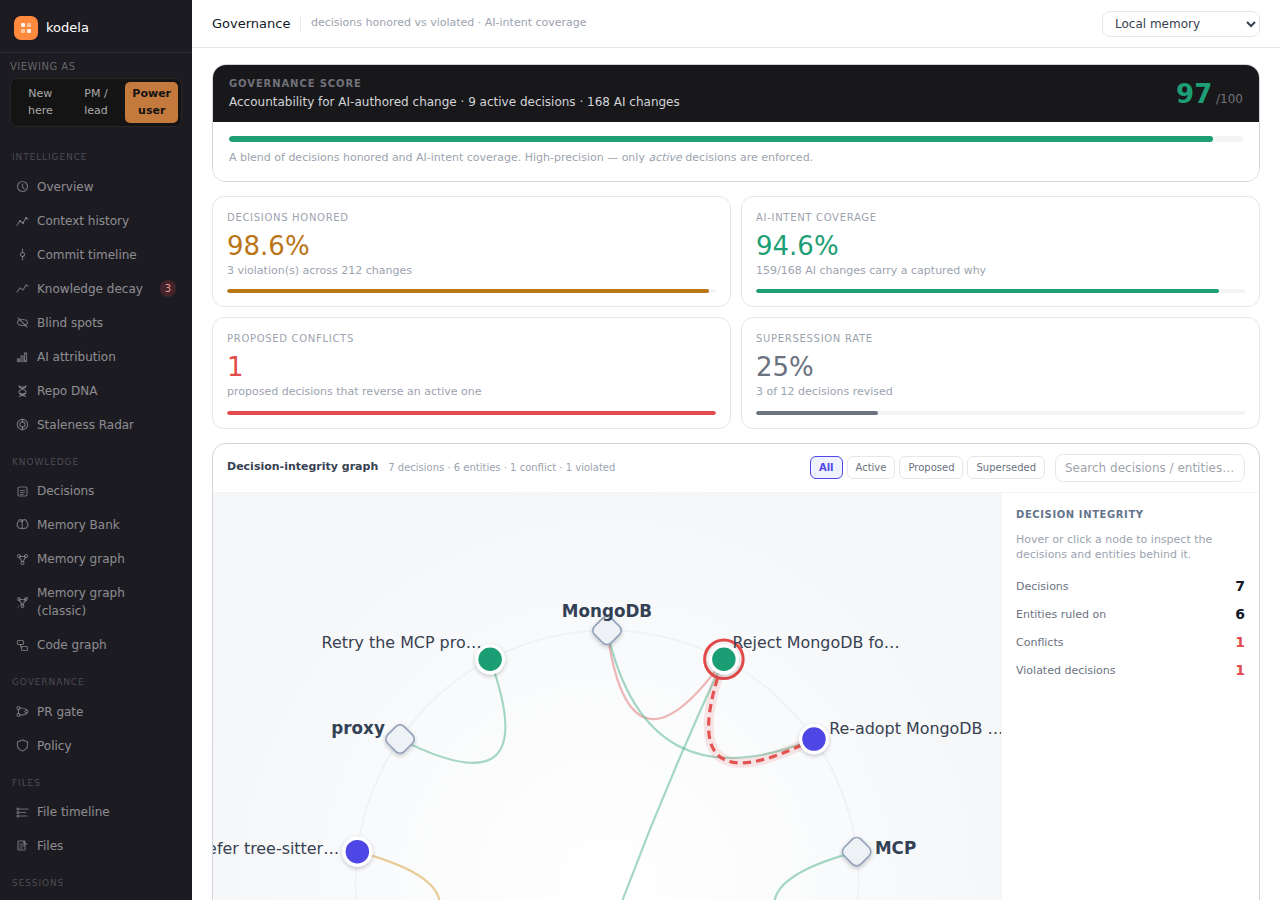
Decisions honored vs violated, the share of AI changes carrying a captured why, and an interactive decision-integrity graph — decisions fused with the entities they rule on, conflicts in red, searchable and highlightable — that surfaces tension clusters at a glance. One tested engine behind the agent guard, the CLI, the PR check, and this dashboard.
Talk to our team
Tell us about your environment and governance requirements, and we'll help you evaluate Team, Cloud, or Enterprise.